EARTH, SKY AND HOMO SAPIENS IN THE MIDDLE
Startsev A. A. Grand PhD, Professor of the International University of Fundamental Education, Oxford Educational Network, Member — Correspondent of the Russian Academy of Nature Science, Member of the Russian Academy of Ecology, Director of the International Centre for the Promotion of UNIDO Programs and Projects Implementation, UNIDO International Expert,
Peter the Great Saint-Petersburg Polytechnic University, St. Petersburg, Russia
Annotation
Modern civilization is evolving in the direction of continuing and deepening instability of the evolution of mankind, being at the mercy of spontaneous uncontrolled development. Such spontaneous development distorts the genetic programs of a person, transforming them into modern culture and human behavior based on the paradigm of «postmodernity». That is, the entire set of socio-political ideas that dominate in society at the present stage, leading to the decline, the elimination of the meanings and essence of the existence of earthly civilization. The main reason is that people in the «postmodern» paradigm — policy-makers — at any level, for any scale of space and time, do not understand the natural scientific foundations of the sustainability of life, which are closely related to Heaven, Earth, and Homo sapiens. It is clear that such a paradigm in principle cannot ensure the sustainability of human development and the preservation of life on Earth.
Keywords: The Amsterdam Declaration, the Earth system, the paradigm of «postmodernity», global changes, biotic regulation, the epoch of the constellation of Aquarius, the power of the Sky, the vibrational (wave) picture of the world, nature-like development, ecologically disenfranchised man, the tectonic process of global transformation, the ecologization of thinking.
“And yet, with devilish persistence, we strive to destroy it”
António Guterres, head of the UN
The Amsterdam Declaration on Earth
In July 2001, the international conference “Challenges of a Changing Earth: Global Open Science Conference” was held in Amsterdam, which is of great importance for understanding the problems of the modern organization of life on planet Earth. Following the conference, its participants adopted the so-called “Amsterdam Declaration”. The main conclusions drawn by the authors of the Amsterdam Declaration are as follows:
The Earth System behaves as a single, self-regulating system comprised of physical, chemical, biological and human components. The interactions and feedbacks between the component parts are complex and exhibit multi-scale temporal and spatial variability. The understanding of the natural dynamics of the Earth System has advanced greatly in recent years and provides a sound basis for evaluating the effects and consequences of human-driven change.
Human activities are significantly influencing Earth's environment in many ways in addition to greenhouse gas emissions and climate change. Anthropogenic changes to Earth's land surface, oceans, coasts and atmosphere and to biological diversity, the water cycle and biogeochemical cycles are clearly identifiable beyond natural variability. They are equal to some of the great forces of nature in their extent and impact. Many are accelerating. Global change is real and is happening now.
Global change cannot be understood in terms of a simple cause-effect paradigm. Human-driven changes cause multiple effects that cascade through the Earth System in complex ways. These effects interact with each other and with local- and regional-scale changes in multidimensional patterns that are difficult to understand and even more difficult to predict. Surprises abound.
Earth System dynamics are characterised by critical thresholds and abrupt changes. Human activities could inadvertently trigger such changes with severe consequences for Earth's environment and inhabitants. The Earth System has operated in different states over the last half million years, with abrupt transitions (a decade or less) sometimes occurring between them. Human activities have the potential to switch the Earth System to alternative modes of operation that may prove irreversible and less hospitable to humans and other life. The probability of a human-driven abrupt change in Earth's environment has yet to be quantified but is not negligible.
In terms of some key environmental parameters, the Earth System has moved well outside the range of the natural variability exhibited over the last half million years at least. The nature of changes now occurring simultaneously in the Earth System, their magnitudes and rates of change are unprecedented. The Earth is currently operating in a no-analogue state [1].
Given a number of the conceptual points noted, the authors of the Amsterdam Declaration considered it necessary to agree on the following:
An ethical framework for global stewardship and strategies for Earth System management are urgently needed. The accelerating human transformation of the Earth's environment is not sustainable. Therefore, the business-as-usual way of dealing with the Earth System is not an option. It has to be replaced—as soon as possible—by deliberate strategies of good management that sustain the Earth's environment while meeting social and economic development objectives.
A new system of global environmental science is required. This is beginning to evolve from complementary approaches of the international global change research programmes and needs strengthening and further development. It will draw strongly on the existing and expanding disciplinary base of global change science; integrate across disciplines, environment and development issues and the natural and social sciences; collaborate across national boundaries on the basis of shared and secure infrastructure; intensify efforts to enable the full involvement of developing country scientists; and employ the complementary strengths of nations and regions to build an efficient international system of global environmental science.
The global change programmes are committed to working closely with other sectors of society and across all nations and cultures to meet the challenge of a changing Earth. New partnerships are forming among university, industrial and governmental research institutions. Dialogues are increasing between the scientific community and policymakers at a number of levels. Action is required to formalise, consolidate and strengthen the initiatives being developed. The common goal must be to develop the essential knowledge base needed to respond effectively and quickly to the great challenge of global change [2].
According to Russian scientists (Academician of the RAS K. Ya. Kondratyev, Doctor of Geographical Sciences K. S. Losev), the Amsterdam Declaration has undoubtedly become an important new step forward in understanding the development paths of modern civilization, especially in view of the interactive complexity of the accumulated problems requiring solution. And, most importantly, in developing a new development paradigm instead of moving by inertia on the basis of the principle of “business as usual” and “after us, the deluge”.
One can only regret that during the preparation of the Amsterdam Declaration, the relevant conceptual work carried out by scientists in the USSR starting from 1960, and later in Russia, was completely ignored—the results of which were already summarized in the 90s in scientific papers and monographs dedicated to the Theory of Biotic Regulation of the Environment and Climate, and further in a series of monographs published by PRAXIS (United Kingdom). Then, over the past twenty years, a whole series of foundational publications appeared in Russian editions in fields related to biotic regulation [3], [4].
On Biotic Regulation
The interdisciplinary Theory of Biotic Regulation of the Environment and Climate (formulated in Russia in 1995 by Doctor of Physical and Mathematical Sciences V. G. Gorshkov) is, essentially, one of the fundamental laws of nature. This theory quantitatively proves that the environment remains suitable for the diversity of life as a result of the stabilizing effect of natural ecosystems upon it.
Academician V. I. Vernadsky back in the first half of the twentieth century put forward three fundamental propositions of ecology: on the role of living matter in shaping the environment (1922), on the necessity of nutrient cycles, and on the impossibility of the free development of humanity outside the coordination of its activities with the laws of functioning of the biosphere (1944).
A follower of Vernadsky, N. V. Timofeev-Resovsky, developed the Academician’s ideas and in 1968, based on them, formulated the concept of environmental regulation by the biota—the community of all living organisms, consisting to 99 % of microorganisms and fungi (moulds): “The Earth’s biosphere is a gigantic living factory transforming energy and matter on the surface of our planet; it forms both the equilibrium composition of the atmosphere and the composition of solutions in natural waters, and through the atmosphere—the energetics of our planet. It also influences the climate. Let us recall its enormous role in the moisture cycle on the globe... The biosphere forms the entire environment of man. And a careless attitude towards it, a disturbance of its proper functioning, will lead not only to a reduction in food resources, but will also undermine the functioning of the planet’s gaseous and aqueous environment. Ultimately, people without a biosphere, or with a poorly functioning biosphere, will not be able to exist on Earth at all.”
At the end of the twentieth century, V. G. Gorshkov developed this concept into the theory of biotic regulation of the environment and climate, having carried out enormous work on synthesizing and analysing colossal factual material. It follows from this theory that natural ecosystems represent structural units of the biosphere, analogous to natural landscapes and the biogeocoenoses that compose them. The latter serve as the primary indivisible cells of the ecosystem. On extensive factual material, it was shown that life materialized in biota builds the environment and controls it in the interests of the biota itself, ensuring the dynamic stability of the environment. Within the framework of the biotic regulation theory, the limit of permissible destruction of natural ecosystems by human economic activity was also determined, which is called the ecological carrying capacity or economic carrying capacity (in contrast to demographic carrying capacity). In effect, a hitherto little-known law of nature was formulated, which humanity can no longer continue to ignore [5].
Thus, the essence of biotic regulation consists in the scientifically substantiated proposition that life itself maintains the stability of the environment optimal for its own existence. The regulation of environmental stability occurs through highly complex information exchange and is just as inherent a property of life as, for example, nutrition and reproduction.
For the first time, V. G. Gorshkov determined the rate of analysis, processing and exchange of information between the Earth’s natural ecosystems. It turned out that this rate exceeds the computational capabilities available to our civilization a sextillion (1 × 10²¹) times over. The process of maintaining the stability of the environment and climate on Earth is characterized by such fantastic complexity. Even if the programme for environmental management were to become known, we could never create the necessary automated system for environmental and climate management analogous to Earth’s natural ecosystems. But this programme itself is unknown to us—we do not know how to prevent droughts, floods, temperature fluctuations, or how to stabilize the chemical composition of the atmosphere and soil in a state suitable for our life. Therefore, the only condition for preserving conditions suitable for life on Earth is the preservation of natural ecosystems. Their destruction leads to a loss of climate stability [6].
It is clear that each individual maintains the vital stability of the internal environment of its organism. But a living individual also exists in the external environment. Therefore, the internal environment is rigidly connected to the external one. For ecosystem organisms forming a continuous immobile living layer (these are plants synthesizing organic matter, and the smallest organisms—bacteria and fungi—decomposing it), the internal environment is inseparable from the external one.
To understand the conditions of interconnectedness between the biota and the external environment, it is important to know that the biota can exist and perform its function only in natural ecosystems—undisturbed (climate-regulating) forests, wetlands, meadow systems with a natural fertile soil layer, in tundra, forest-tundra, etc. In artificial and disturbed ecosystems—parks, forest parks, tree plantations, drained bogs, industrially logged forests, including as a result of sanitary clear-cutting, as well as in burned forests, landscape design ponds and water bodies, on agricultural fields, in deserts and semi-deserts—biota cannot exist.
From the perspective of biotic regulation, the most important dynamic parameter distinguishing natural ecosystems from others is their degree of disturbance. For information, the area of all types of clear-cutting of forests in Russia is about 1.3 million hectares per year, and illegal logging is several times greater. The area of forests destroyed by fires in our country is estimated at approximately 6 million hectares per year, and this process is on the rise. There is a view that the logging and destruction by fire of natural forest can be compensated for by tree plantations. This is a profound misconception. Tree plantations can only, over decades, restore the lost stock of timber.
The climate-regulating functions of forests are restored over centuries in the course of a most complex natural process of ecological succession—a strictly defined sequence of the emergence of biological species (lichens, mosses, herbs, shrubs, trees) replacing one another to fully restore the environment and the mechanism for controlling it. The lost climate-regulating potential of a natural forest cannot be restored by tree plantations. Taking into account the mounting negative dynamics in climate change (droughts, floods, storms, hurricanes, etc.), this means—never in the foreseeable future [7].
According to UN data (https://tass.ru/infographics/9495), in recent years desertification has reached dramatic proportions. The planet loses 100 million hectares of agricultural land annually. This is the area of Egypt or 23 Moscow Oblasts. Such a catastrophic rate of destruction of life by man cannot continue for long—the existence of not only the biota, but also humanity is at risk.
It is high time, finally, to switch on reason and grasp that natural ecosystems exhibit maximum stability to abiotic (wildfires, windthrows) and biotic (insect infestations) disturbances. In these ecosystems, all biota species have a stable population density from generation to generation. Following a serious disturbance (of an anthropogenic nature) exceeding the stability threshold of a natural ecosystem, it cannot, as has been shown, spontaneously return to its stable state.
What should be done, first and foremost, to slow down the processes of environmental destruction and help mitigate the consequences of global climate change?
First, take measures to preserve wild forests (little-disturbed forest territories) from destruction, in which the natural dynamics of forest self-recovery and their capacity for biotic regulation of the environment and climate are preserved.
Second, sharply reduce the scale of forest fires through the use of digital systems for early detection of hotspots and the prompt prevention of the further spread of fire (specialists note: if firefighting measures are not taken within half an hour, subsequent fire suppression turns into a grand and complex problem).
Third, afforestation: the cultivation of forest plantations, above all on disused agricultural lands. Currently, the total area of such lands is estimated at 76 million hectares, and by 2030 it will already be around 100 million hectares. The timber grown on forest plantations is intended to replace economic needs for timber currently harvested from wild forests.
The Starry Sky Above and the Moral Law Within Us
“Two things fill the mind with ever new and increasing admiration and awe, the oftener and the more steadily we reflect on them: the starry heavens above and the moral law within.”
Immanuel Kant
The metaphysical sensation of the Power of Heaven has since ancient times permeated the culture of all peoples of the Earth.
To understand the periodic processes of planetary development in the cosmic epochs accessible to historical memory of the energies of the constellation of Aries (2306–146 BCE), then the constellation of Pisces (146 BC – 2013 AD and, finally, the new epoch of the constellation of Aquarius that began in 2014, it should be noted that time is regarded not as duration (Greek Chronos), but as the order of succession of events (Greek Tsiklos). It looks like a twisting spiral, similar to a snail's shell. And by our time, having left past civilizations on its wide coils, the turns are contracting toward a point that scientists have called the anthropological turn of the middle of the twenty-first century.
The Holy Apostle John says in the Apocalypse: “I saw a new heaven and a new earth: for the first heaven and the first earth were passed away; and there was no more sea” (Rev. 21:1). Righteousness will dwell there, as the full and perfect realization of justice, which does not exist on the present earth.
With the onset of the astronomical epoch of the constellation of Aquarius, vibrations of the Power of Heaven of a higher octave came to Earth: that which Pythagoras called the “music of the spheres”, and scientists call the quantum transition, vibrational transformations contributing to the awakening of consciousness.
The vibrational picture of the world, or the wave nature of the world, existed in the worldview of the multi-ethnic people of ancient Rus in the pre-Christian, pre-religious era. In those times, there existed the concept of “winds” (in modern terms—vibrations). Three types of “winds” were distinguished: celestial (cosmic vibrations), terrestrial vibrations, and vibrations of the human organism. In that worldview paradigm, man was supposed to be in harmony with two winds (cosmic and terrestrial). That is, to listen to the immaterial, to hear these vibrations, to sense them and understand them. Following the sounds of these vibrations, to adjust one’s existence and be in unity and harmony with nature (nature-like existence).
Modern civilization has long departed from the understanding of the vibrational picture of the world and follows a mechanistic-materialistic picture of life organization, which has led humans today into a state of imbalance with the environment. Many are already beginning, consciously or unconsciously, to realize that humanity is in an acute phase of a civilizational crisis. And for our continued existence on the planet, radical transformations are needed in literally all spheres of society.
In his programmatic article “Russia muscles up – the challenges we must rise to face” (16.01.2012), V. V. Putin described what is happening in the world as follows: “...what the world is facing today is a systemic crisis, a tectonic process of global transformation. It is a visible manifestation of our transition to a new cultural, economic, technological and geopolitical era. The world is entering a period of turbulence, which will be prolonged and painful.” [8].
A new cosmic epoch has begun. And that means new meanings, new creeds, new goals, new borders on the political map of the world. Everything will be different. Grace will be attained by those who with a pure heart accept the Power of Heaven and attune into resonance with the Will of Heaven, learning to live in harmony with the world of natural harmony surrounding man. Let us emphasize: not in digital form with artificial intelligence (these are merely tools to facilitate the solution of various socio-economic tasks), but in harmony, which represents not balances, but a coherent proportionality of unequal parts, of which there are at least three.
On cosmic grounds, the advent of the epoch of the constellation of Aquarius (the sign of Russia), with the focus of energies from Valdai to Altai, by the natural course of things, including force majeure circumstances, will foster great changes associated with the transfiguration of Russia. Changes are an objective process, and they are needed because technological progress has run into the limits to growth. This occurred when the several-centuries-long progress of the industrial society of expanded reproduction of capital and ever more complete satisfaction of people’s material needs reached the “edge of the precipice”—on ecological grounds (the balance between the technosphere and the biosphere is broken), fossil raw materials and bad debts of all kinds (total global debt has surpassed the 315 trillion dollar mark). That was when the fundamental crisis set in. And the goal of the upcoming changes is a new nature-like world order.
President of the Russian Federation V. V. Putin stated, speaking at the end of September 2015 at the 70th session of the UN General Assembly, that setting quotas for CO₂ emissions is merely a temporary tactical measure, while the strategic solution to the problem of climate change is to “restore the balance between the biosphere and technology upset by human activities”. At the same time, V. V. Putin called for uniting the efforts of states that “possess strong research and development capabilities, and have made significant advances in fundamental research” to address this task, as well as developing nature-like technologies [9].
Unfortunately, this statement by the head of our state was not taken into account at the stage of Russia’s participation in developing the Paris Climate Agreement of 15.12.2015 and its subsequent adoption of this international treaty. The “moral law within” did not work. Despite the coherent Theory of Biotic Regulation of the Environment and Climate (a fundamental law of nature) formulated in Russia, the Russian Federation nevertheless signed the Paris Agreement in April 2016, and in November 2019 the Agreement entered into force for Russia—with the subsequent unfolding of the fight against global warming by reducing emissions and absorbing CO₂.
On 26 October 2023, by Decree of the President of the Russian Federation, a new Climate Doctrine of the Russian Federation was adopted. The fact of its appearance shows that the pro-Western course toward decarbonization of all economic activity is maintained. At the same time, the doctrine still does not take into account the main scientific factor—the mechanism of biotic regulation of environmental and climate stability discovered by Russian scientists. The authors of the doctrine that formed the basis of this Decree are confident that by 2060, by some cunning means—so-called forest climate projects—they will more than double the absorption of CO₂ by our forests, without specifying how they will “force” our forests to absorb carbon more than twice as effectively as is currently the case.
If someone believes that forest biota does nothing but absorb CO₂, then this gas would long since have ceased to exist in our atmosphere. And there would be no life on Earth. It is impossible by any means to “force” our natural forests to absorb more carbon than is currently the case. Especially when ruthless destruction of wild forests is taking place. And at the same time to “force” our forests to respire half as much, to “force” soil organic matter to decompose half as much. This is complete absurdity. In the presence of anthropogenic sources of CO₂, from the standpoint of science, from the standpoint of the global carbon cycle, there can be no question of any carbon neutrality by some arbitrary year. It will occur only when all fossil fuels have been consumed.
The metamorphoses of the new climate doctrine lead our country even deeper into a complete dead end and hinder the understanding of the prevailing distorted picture of the world, obstructing movement toward the nature-like (wave) essence of processes in the biosphere. In nature there is no progress, but rather the cyclicity of wave processes. Heaven is threefold. The circle of celestial spheres, trajectories, and orbits has no edges or breaks. In a circle there is neither beginning nor end. The development of a circle onto a plane gives a wave. A wave is a mode of propagation of radiant energy: visible and invisible. A wave has three measures: amplitude, frequency, phase. Therefore, the Cosmos in human perceptions is threefold.
Being is likewise threefold—it is Heaven, Earth, and Man between them. Time is threefold as rhythm, as cycle, and as phase of energy arrival. Consciousness is threefold as bodily instincts, soul reflexes, and spiritual passions.
Knowledge is threefold as science, art, and religion. Wisdom is threefold as faith, hope, and love. Ethics is threefold as good, evil, and justice. The organizing principle of society is threefold: it is individualism, collectivism, and joint responsibility.
Heaven, Earth, and Man between them are united by the universal Law of Changes in bundles of three forces, known to the Chinese since antediluvian times and absent from textbooks, dictionaries, and encyclopaedias of the countries and peoples of the Biblical civilization. Thus, the Will of Heaven on Earth is manifested according to the Law of Changes in bundles of three forces. In Christian dogmatics, this is the Life-Giving Trinity. The Phenomenology of the Spirit is subject to the Law of Changes just as the periodic system of chemical elements of non-living nature (D. I. Mendeleev's table) and the DNA system of living nature, including humans, are subject to it.
Homo sapiens — Disenfranchised Man
The fundamental difference between humans and animals lies in the fact that the cellular life processes of all species of living organisms are based on a genetic programme encoded in the DNA macromolecule. In all plants, bacteria, and fungi, which perform all the functions of biotic environmental regulation, these functions are based solely on information contained in the DNA molecule. Plants, bacteria, and fungi (the main component of the biota) have neither heads nor brains. The basis of animal actions (behaviour) is positive and negative emotions encoded in DNA that preserve the animal's life in its environment.
In animals, only DNA information is transmitted to subsequent generations, while all memory information accumulated during life decays with the death of the animal. This feature of accumulating memory for only a single lifespan maintains the stability of the species in its environment. DNA information has been verified by scientists across many generations, ensures the stability of life, and remains practically unchanged throughout a species’ existence of some several million years. Conversely, information accumulated in DNA memory inevitably contains false, harmful, or unnecessary elements for subsequent generations. Therefore, memory must be eliminated upon the death of the individual.
Man is the only biological species in the animal kingdom that has broken this rule. Memory information accumulated during a person's life is transmitted and assimilated by subsequent generations. This information of inherited memory, supplementary to DNA, constitutes the culture (different cultural codes) of the human population. Culture—above all, ethics (what ought to be, what is permitted, and what is forbidden) formed in a person within the family and surroundings—contains both useful and false, harmful elements for the stability of the population. Some of them take the form of folklore, rites, rituals, legends, epics, beliefs, superstitions, mysticism, various kinds of religious dogmas, and fanatical rules of human behaviour. False and harmful cultural rules of behaviour during certain historical periods often led entire human populations to perish. Only those survived that supported the stability of societal life across generations. But accumulated culture substantially altered the environment surrounding humans. And that culture which ensured societal stability in the past became destructive to society in a subsequent period of its existence. Therefore, modern culture, having absorbed the toxic elements of the “postmodern” paradigm, is in contradiction with the originally unchanging genetic programme of general human behaviour.
The accumulation of diverse cultural heritage became possible only as a result of the genetically determined, highly developed social behaviour of Homo sapiens. However, such behaviour, negatively affecting the environment, also gave rise to the problem of the loss of fundamental human ecological rights [10].
All living beings require water and food. Humans are no exception. Therefore, the rights to food and water are officially recognized as inherent human rights protected by the International Convention on Human Rights. That is, these rights are determined by the biological constitution of the human organism, by its biological needs. Looking at humanity from a global perspective, we see that a whole series of fundamental ecological rights have been lost: to personal territory, to social significance, to inner harmony. The impression is created that these ecological rights were lost even before people realized that they existed.
In the general case, rights are determined by normal needs in the course of life activity. Originally, man was created to move and to have the right to personal territory of the order of 4 km². The power of existence of the human body is about 150 Watts. This is the power of two light bulbs. This power, called metabolic power, is spent on maintaining biochemical processes in the human body. Energy enters the body with food. Food for humans in the conventional sense is produced by the ecosystems of the biosphere.
The biosphere receives energy from the Sun. Green plants convert part of this energy into the energy of organic substances used as food by humans and other animals. Biosphere productivity averages only 0.5 W/m². This is very low power. It cannot support the needs of a stationary human body, which requires, per square metre, thousands of times more power. In modern society, per capita power consumption is about 2.5 × 10³ W (table), which exceeds the biological energy consumption of one adult human (150 W) by more than an order of magnitude. One can say that for every person, more than ten robots are working with power equal to the power of an adult human.
From the assessment of the first two fundamental parameters—the metabolic power of the human body and the productivity power of the biosphere—we unequivocally conclude that human beings must move and gather food growing across a vast territory. That was how it was in the prehistoric era. Obviously, this territory had to be defended against potential intruders claiming the same food. In other words, humans were created to move and possess a large personal territory. Today everything is different. This right has been violated on an unprecedented scale. The unprecedented growth of the human population over the past century has led to a situation where the average inhabitant of the planet can call their own a territory of no more than a hundred square metres. The size of the individual territory of a modern human is smaller than the individual territory of a mouse! And the popularity of personal motor vehicles, as well as the urge to travel, are driven by people’s desire to recreate the illusion of moving across a large territory. But this is merely an illusion [10].
The third—variable power parameter (2500 W/capita) shows that the further development of automation, digitalization, and robotization leads to physical labour, necessary to man in a certain amount, becoming a deficit. Some compensate for this deficit in gyms, some by renovating their homes, improving their household at the dacha, etc. However, for the overwhelming majority of inhabitants of urban agglomerations, this deficit is worsening.
In undisturbed ecosystems, the right to individual territory is sacredly respected among all wild animal species. For mammals, there is a universal relationship between the area of an animal’s personal territory and its size. It has been proven that this area grows approximately in proportion to body weight. For example, small animals such as mice and shrews need only small plots of personal territory on the order of several hundred square metres for normal life activity. Large animals such as bears, elk, or elephants control vast territories whose size can reach hundreds of square kilometres. And modern humans alone have found themselves completely deprived of this fundamental right.
However, an environment suitable for life is unstable. Conditions supporting human life are provided by the natural biota, in which the main energy flows are consumed by plants, bacteria, and fungi. In the course of the evolution of large animals, to which humans also belong, they lost genetic information regarding environmental regulation. The genetic programme of humans, as of other large animals, entails introducing disruptions into the environment. The environment has been subjected to particularly severe destruction in megacities and large cities burdened by industrial production. There, one cannot speak at all of compliance with the norm of Article 42 of the Constitution of the Russian Federation (Everyone has the right to a favourable environment...).
Today, more than 80% of Russian citizens live in megacities and large cities, and the trend toward growing urbanization is increasing. To see that many dreadful features of modern civilization have as their cause the loss of the fundamental ecological right to personal territory, it is sufficient to look at the situation in modern urban agglomerations, especially in the so-called “human hives”—exponentially growing housing estates of 25–30-storey apartment buildings.
We are at the peak of a construction and mortgage crisis; it is already marching widely across our country. It is another matter that developers, as participants in the construction groups of megacities, strive in every way to cover up this crisis with various kinds of fine words.
They try not to accentuate facts and figures that are risky to evaluate, but, in essence, it is clear that the construction industry has long since shifted into the format of the dominant trend of Russia’s development, practically determining the country’s economy. On the one hand, this is because construction today is one of the most seemingly lively economic phenomena on the surface. On the other hand, for a long time now a large industrial part of the country, as well as an army of migrants from neighbouring countries, has been working for construction (and not only). Here, colossal state subsidies, huge bad loans primarily to state banks, failures in migration policy, the ecological rights of inhabitants of “human hives”, and problems of education, healthcare, demography, jobs, etc., have all merged. One gets the impression that no one today truly grasps the real economics of the entire construction sector of megacities, or rather does not even have it before their eyes in any rational form.
It turns out that we are all becoming hostages to this momentum of the megacity construction groups, when stopping is impossible—nothing personal, just business. On the other hand, what it does undoubtedly cannot fail to create risks for national security, not to mention the interests of citizens in somehow meeting the vital needs of their existence. These are the millions of citizens whose ancestors lived in villages and hamlets, but were cast into large cities in search of a better life. Today, these millions of citizens are for the most part disoriented. And tens of thousands of villages and settlements have become depopulated.
Fifteen million city dwellers “sitting on each other's heads” are not inclined toward mutual assistance, for they have been brought up in the spirit of individualism, mutual competition, and personal success. Sometimes these people speak entirely different languages. And herein lies another set of problems, ethnic and social. A megacity is a layer cake consisting of cultural and ethnic enclaves, at times very, very isolated. Under conditions of waning public trust in state authority, a city crammed with property, social, cultural, and ethnic contradictions becomes a “trap”, and under external influence it could also become one great arena of “gladiatorial combats”, where everyone is against everyone.
Probably, before our very eyes, the normalization of the liberal Strategy for Spatial Development of Russia, adopted in 2018 and focused on the development of agglomerations while neglecting the rest of the country’s territory, is beginning.
Summing up, let us emphasize that humans are not mice and cannot normally implement their genetic programme and be human while jostling one another with their elbows on tiny personal patches, especially on the upper floors of “human hives”. People are perhaps not bad. They are simply deeply unhappy. And the thousands of laws being adopted still fail to make them happier.
Russia occupies 11.46% of all the Earth’s land with less than 2% of the planet’s population. The country’s territory is mostly in a cold climatic zone. Globally, on average, there are 40 persons/km², in the central part of Russia—8, in Siberia and the Far East—2, and in areas of the Far North—from 0.3 to 0.01 persons. At the same time, in Japan it is 350, and in China—135. Russia needs to develop its territory, but not arithmetically (“Far Eastern and Arctic hectare”, million-plus cities in Siberia)! Both economy and war today are logistics. Siberia and the Far East must be “reunited” on a new technological and socio-economic basis, proceeding from the natural-scientific foundation of life sustainability. Such a theory exists.
In Conclusion
The information society of the new cosmic epoch of energies of the constellation of Aquarius in the course of global transformation will either preserve its human face with reliance on traditional values of life (the lot of the countries of the East), or follow a false path in the paradigm of “postmodernity”—transhumanism, artificial intelligence, genetically modified human-cyborg, and total digitalization (the lot of the civilization of the West).
“Oh, East is East, and West is West, and never the twain shall meet, / Till Earth and Sky stand presently at God’s great Judgment Seat”, foretold the prominent Freemason R. Kipling.
In the oncoming information society, the priority of aggregate power shifts to intangible aspects of values, especially culture: the call of the heart, the spirit of creation, the potential of capacities to create the new, the unprecedented, often the paradoxical.
The threefold nature of Homo sapiens (body—soul—spirit) is repeated in the psychological makeup of a people (instincts—reflexes—passions), as well as in the threefold nature of social life (interests—values—sacred things). And all of this in the energies of life is conjoined with the Will of Heaven [11].
Nature acts as an absolute priority among intangible values as the condition for the existence of the diversity of life on Earth, including humans. If there is no Nature (the biosphere is destroyed), then there is no Life either. Therefore, in the coming so-called information society, Homo sapiens faces a triune goal: Cognition of Life, Preservation of Life, and Continuation of Life on Earth.
Cognition of Life. In the post-industrial era, knowledge and information acquire special significance. But not extensive “hanging out” on social networks, wandering through the endless web of Internet resources or digital libraries, but the search for answers to the profound questions of our life: How is the living world organized? What drives everything? What does the sustainability of life itself, favourable for human existence on the planet, depend on?
The main blank spot in modern science still remains the question of how ecosystems undisturbed by humans—forests, wetlands, tundra, oceans—are organized? How has life in them remained uninterrupted, while the environment preserved its stability and remained suitable for life for hundreds of millions of years? This is the first main question of the global project. And an exhaustive answer must be provided to it, drawing upon the achievements of Russian fundamental science—the Theory of Biotic Regulation of the Environment and Climate, which quantitatively assesses the stabilizing effect of natural ecosystems on the environment and the dynamics of climate change (one of the most important laws of nature). In doing so, an interdisciplinary approach should be used, rather than isolated narrowly specialized studies.
If, however, the phenomenon of life is studied while ignoring biotic regulation, what results is shown in the figure, where the researchers can say nothing coherent about the object of study as a whole.
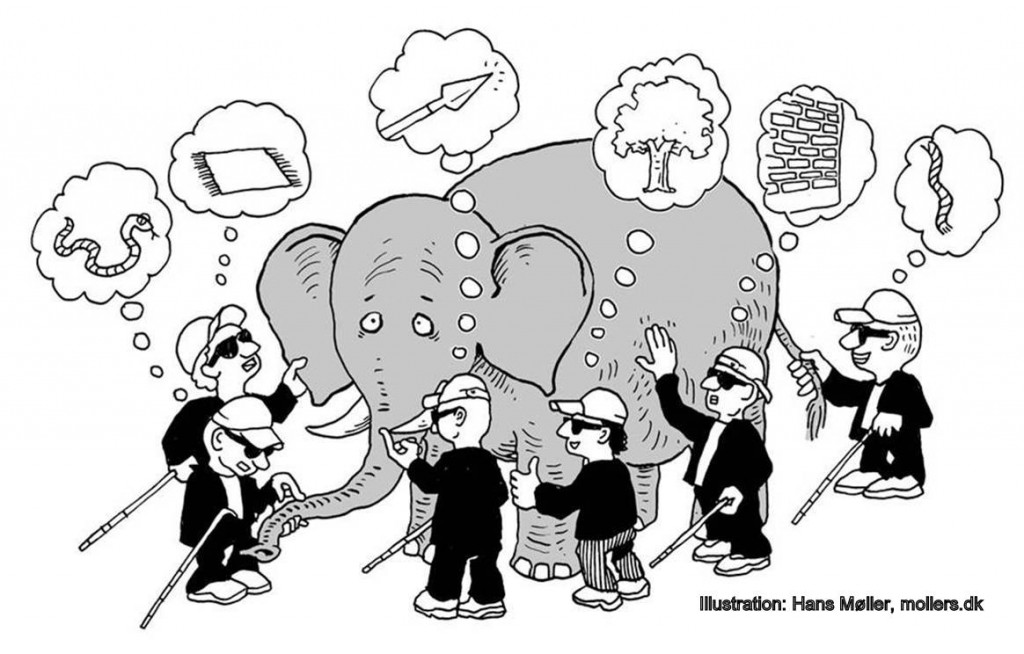
A fragmentary, perhaps even deep perception of some single aspect of the problem of the phenomenon of life does not allow one to see the picture in all its completeness, integrity, and adequacy.
Preservation of Life. Since civilization has approached a critical threshold in its history—a possible “point of no return”, in order to preserve life it is necessary, above all:
- 1) remedying the damage inflicted over many decades upon the environment and the spiritual world of man (the dominance of xenomania), otherwise an uncritical attitude toward the mounting disturbance of the balance between the technosphere and the biosphere, and the atomization of social relations, will become irreversible, after which all actions of people will prove powerless;
- 2) fulfilling the behest of Academician V. I. Vernadsky that “humanity cannot freely build its history, it can build it only taking into account the laws of the biosphere” (1944);
- 3) “ecologization” of thinking as an additional component in the system of forming a new worldview, goals of social development, and strategies for achieving them in a global context; a transition to the use of nature-like (wave) technologies with the simultaneous implementation of a planetary system of ecological and climatic observations using conventional and satellite means to ensure adequate monitoring of processes in the biosphere and the environment; high-precision data processing and forecasting in order to prevent further destruction of the biosphere; control over the effectiveness of measures to remedy the disturbed balance between the technosphere and the biosphere. This will be more important than the project of flights to Mars (suppose one could fly away, only there would no longer be anywhere to return to).
Continuation of Life. To understand and accept the values and meanings of the new Being and to follow them: to learn to live in agreement with the world of natural harmony surrounding man—this is the formula and condition for the continuation of life (to be in harmony with nature is a simplified understanding of the essence of life sustainability). The determining factor here must be the development of adequate indicators of the creative potential of the state-forming nation and the nature-supporting development of the country, including composite ones, similar to GDP and the “grace index” (for preserving the natural environment and organizing the life activity of the creator-human in conditions of an urbanized environment). The criterion lies in assessing the stabilizing potential of preserved natural ecosystems in such an amount that their capacity is sufficient to maintain the environment in a state suitable for the diversity of life in general and humans in particular. In the resulting “green corridor”, our civilization can develop indefinitely, utilizing any energy sources and reaching any technological and intellectual heights.
Where should one begin moving toward the goal? From the realization that the mechanistic-material picture of the world (in the paradigm of “postmodernity”) is defective and leads to destruction. Within the framework of this unjust picture of the world, there can be no reasonable way out. This civilizational matrix was created specifically to serve inequality, the dominance of a handful of so-called “elites” over the rest of the world. In the words of the EU High Representative for Foreign Affairs and Security Policy Zh. Borrell, one of the adherents of the hybrid war unleashed by the global “backroom actors”, this is a war for a new world order, and it is being waged in the interests of the “flowering garden”—people from the so-called “golden billion” of the countries of the collective West. The rest of the non-Western world is the “jungle”, which must be reformatted to suit their needs and turned into colonies of a new type, ruthlessly draining vital natural resources from there.
It is possible and necessary to resist this. It is necessary to regain the ancestral memory of the forebears with their vibrational (wave) picture of the world. To listen to the immaterial, to hear these vibrations, to sense them and understand them. Following the sounds of these vibrations, to adjust one’s existence and be in harmony with the world of natural harmony surrounding man (nature-like existence).
Nature-like existence is inextricably linked with life organization on the principle of the neighbour-territorial community, with the cult of the family and joint responsibility, the basis of which among ancestors was a spiritual meaning rather than socio-economic relations (collection of taxes, tributes, etc.). One could traverse one’s spiritual path only collectively. Ancestors knew with certainty that spirituality could not be attained individually. And the essence of joint responsibility is a spiritual vocation and the acquisition of grace (give what you have in abundance, and receive what you lack). Prosperity (I need more and more) was not held in honour.
12 commandments of grace—a kind of code of honour for the new existence:
- Collectivism and comradely mutual assistance, generosity, unacceptability of loan interest.
- Devotion to the common cause for the common good, love for the Motherland.
- Care for the preservation of natural nature and the multiplication of culture.
- Conscientious labour for the benefit of society (the common above the private).
- High consciousness of public duty, intolerance toward violations of justice, capacity to forgive (mercy).
- Humane relations and mutual respect between people.
- Honesty and truthfulness, moral purity, simplicity and modesty, decency, restraint, knowledge of propriety (norms of ethics).
- Mutual respect in the family, care for the upbringing of children, reverence for elders.
- Irreconcilability toward hypocrisy, envy, pride, greed.
- Friendship of peoples, compassion, magnanimity, intolerance toward ethnic and racial hostility.
- Intolerance toward traitors and enemies of one’s Fatherland.
- Fraternal solidarity with all the peoples of the world.
Perhaps these 12 commandments will become the key unlocking the path to the worldview of a new epoch for a transition to a more just world order, to a traditional nature-like way of life, an exodus from megacities, and the transformation of abandoned villages and settlements. Naturally, on a modern technological base and with appropriate state support.
References
- Steffen W., Tyson P. (Eds.). Global Change and the Earth System: A Planet Under Pressure // IGBP Science 4. Stockholm. 2001.32 pp.
- Ibid.
- Gorshkov V. G. Energetika biosfery i ustoychivost' okruzhayushchey sredy. Itogi nauki i tekhniki. Teoreticheskiye i obshchiye voprosy geografii. T. 7. M.: VINITI. 1990. 238 s.
- Kondrat'yev K. Ya. Klyuchevyye problemy global'noy ekologii. Itogi nauki i tekhniki. Teoreticheskiye i obshchiye voprosy geografii. T. 9. M.: VINITI. 1990.454 s.
- Startsev A. A. Novaya paradigma ekologicheskogo obrazovaniya. Sbornik statey «Noosfernoye obrazovaniye v Yevraziyskom prostranstve». Tom 5. SPb.: TsNIT «Asterion». 2015. S. 129–135.
- Gorshkov V. G. Fizicheskiye i biologicheskiye osnovy ustoychivosti zhizni. VINITI, Moskva. 1995. https://bioticregulation.ru/ab. php?id=vg95&lang=ru
- Makarieva A. M. Pochemu vazhny yestestvennyye lesa. Chasti 1–3. 2024. https://t.me/bioticregulation
- Putin V. V. Rossiya sosredotachivayetsya — vyzovy, na kotoryye my dolzhny otvetit'. 16.01.2012. https://iz.ru/news/511884
- Putin V. V. Vystupleniye na plenarnom zasedanii 70-y sessii General'noy Assamblei OON, N'yu-York, 28 sentyabrya 2015 goda. https://www.mid.ru/ru/foreign_policy/un/organs/general_assembly/70_ya_sessiya_generalnoy_assamblei_oon/1515484/
- Makarieva A. M., Gorshkov V. G., Vel'derer P. A. O nauchnom analize evolyutsii, progressa i budushchego chelovechestva. Energiya: ekonomika, tekhnika, ekologiya. Moskva, NITs «Nauka RAN». 2014. №№ 9–10.
- Devyatov A. P. Kak obustroit' preobrazheniye Rusi. https://telegra.ph/KAK-OBUSTROIT-PREOBRAZHNENIE-RUSI-04-15 15.04.2024