Monograph • 2007
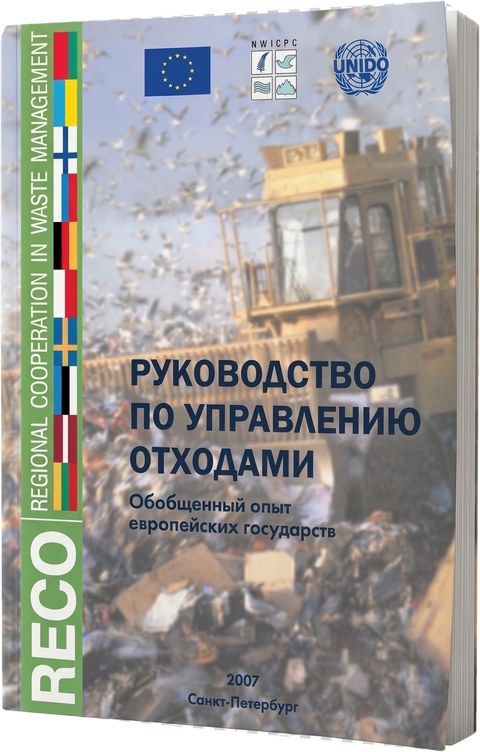
Waste management guide. Summarized experience of European states
Руководство по управлению отходами. Обобщенный опыт европейских государств
Content overview
According to its annotation, the guide was prepared by national experts of UNIDO within the international project RECO East under the BSR INTERREG III B NP programme. As the annotation also states, it considers, in summarized form, the legislative, technological, institutional and economic foundations of handling mainly solid household waste, based on the experience of a number of European countries, gives much attention to analysing the existing situation in waste handling in European countries and to adapting the collected materials to Russian practice, and contains statistical information, graphs, tables and figures. The materials were translated and compiled by A. A. Startsev and M. A. Lyubarskaya.
The table of contents lists a preface and five sections. The first section, the introduction, covers the definitions used in waste handling, the classification of waste, the quantity and composition of solid municipal waste, and the problems that arise from improper waste handling. The second section sets out the regulatory and legal foundations of waste handling: principles and the hierarchy of methods, EU policy and directives, a comparative analysis of the legislative framework for solid waste handling in EU countries and Russia, and international environmental agreements. The third section describes the stages of waste handling (collection, separation and sorting, transportation) and the methods of handling waste (recycling, composting, thermal methods and landfilling), as well as their costs.
The fourth section considers ten specific waste streams, from packaging and waste household appliances and electronics to medical waste and sewage sludge; for each it gives the definition, environmental problems, legal requirements and recycling or management schemes in EU countries. The fifth section deals with the organizational structure of the municipal waste management system: the roles and responsibilities of participants in the Russian Federation and in EU countries, economic instruments, private sector participation, informing the public, including the role of the RECO-East project, and the structure of a waste management plan and the stages of planning.
Contents
- PREFACE14
- 1. INTRODUCTION15
- 1.1. Solid waste management problems15
- 1.2. Definitions used in the field of waste management16
- 1.3. Waste classification17
- 1.4. Quantity and composition of solid municipal waste (TMO)20
- 1.4.1. Quantity of waste in EU countries20
- 1.4.2. Composition of solid municipal waste22
- 1.5 Problems arising from improper waste management25
- 1.5.1. Environmental problems and harm to human health25
- 1.5.2. Consideration of product life cycle when planning a waste management system27
- 1.5.3. Economic problems28
- 2. REGULATORY AND LEGAL FRAMEWORK OF WASTE MANAGEMENT31
- 2.1. Principles of waste management31
- 2.2. Hierarchy of waste management methods32
- 2.3. EU waste management policy: current trends33
- 2.3.1. Modernization of Directives in the field of waste management33
- 2.3.2. Definition of waste, disposal and recovery of waste34
- 2.4. EU directives and instructions in the field of waste management36
- 2.4.1. Main Directives on waste management37
- 2.4.1.1. Directive on waste management37
- 2.4.1.2. Directive on hazardous waste management37
- 2.4.1.3. Transboundary movement of waste38
- 2.4.2. Legislation on various waste management methods39
- 2.4.2.1. Landfilling of waste39
- 2.4.2.2. Waste incineration40
- 2.4.2.3 Waste management standards41
- 2.4.2.4. Waste disposal from ships42
- 2.4.3. Legislation on specific waste streams42
- 2.4.4. Comparative analysis of the legal framework for solid waste management in EU countries and Russia43
- 2.5. International environmental agreements48
- 2.5.1. Convention on persistent organic pollutants49
- 2.5.2. Agreement on waste management at sea49
- 3. STAGES OF WASTE MANAGEMENT50
- 3.1. Waste collection50
- 3.1.1. Waste collection system in containers located near houses52
- 3.1.2 Waste delivery system by households to collection stations54
- 3.1.3. Deposit-refund system for certain types of waste55
- 3.2. Factors affecting the cost of TMO collection55
- 3.3. Waste separation and sorting59
- 3.3.1. Waste sorting by households60
- 3.3.2. Centralized sorting63
- 3.3.2.1. Waste sorting for fuel production66
- 3.3.3. Cost of waste sorting67
- 3.4. Waste transportation and logistics67
- 3.4.1. Transport vehicles and waste transfer stations67
- 3.4.2. Cost of waste transportation72
- 3.5. Waste management methods73
- 3.5.1. Recycling of various TMO fractions74
- 3.5.1.1. Cost of organizing recycling75
- 3.5.2. Composting75
- 3.5.2.1. Composting technologies76
- 3.5.2.2 Costs of composting81
- 3.5.3. Thermal waste management methods82
- 3.5.3.1. Waste incineration methods82
- 3.5.3.2. Cost of waste incineration90
- 3.5.4. Landfilling of waste92
- 3.5.4.1. Organization and operation of landfills for waste disposal94
- 3.5.4.1.1.Gases generated at landfills for waste disposal95
- 3.5.4.1.2. Landfill wastewater95
- 3.5.4.2. Cost of waste disposal at landfills98
- 4. MANAGEMENT OF SPECIFIC WASTE STREAMS100
- 4.1. Packaging and packaging waste100
- 4.1.1. Definition of packaging waste100
- 4.1.2. Environmental problems100
- 4.1.3. Legal requirements101
- 4.1.4. Packaging waste recycling schemes in EU countries101
- 4.1.4.1. Paper and composite packaging106
- 4.1.4.2. Glass106
- 4.1.4.3. Metals107
- 4.1.4.4. Plastic108
- 4.1.5. Packaging and packaging waste management in the Russian Federation112
- 4.2. Waste electrical and electronic equipment (WEEE)116
- 4.2.1. Definition of waste electrical and electronic equipment116
- 4.2.2. Environmental problems116
- 4.2.3. Legal requirements117
- 4.2.4. Recycling schemes for waste electrical and electronic equipment in EU countries119
- 4.3. Hazardous household waste124
- 4.3.1. Definition of hazardous waste124
- 4.3.2. Environmental problems125
- 4.3.3. Legal requirements125
- 4.3.4. Household hazardous waste management schemes in EU countries127
- 4.4. Spent batteries and accumulators128
- 4.4.1. Definition of spent batteries and accumulators128
- 4.4.2. Environmental problems130
- 4.4.3. Legal requirements130
- 4.4.4. Management schemes for spent batteries and accumulators in EU countries132
- 4.4.4.1. Collection133
- 4.4.4.2. Recycling138
- 4.5. Printed matter waste139
- 4.5.1. Definition of printed matter waste139
- 4.5.2. Environmental problems139
- 4.5.3. Legal requirements140
- 4.5.4. Printed matter waste management schemes in EU countries140
- 4.6. Biodegradable municipal waste144
- 4.6.1. Definition of biodegradable municipal waste144
- 4.6.2. Environmental problems145
- 4.6.3. Legal requirements145
- 4.6.4. Biodegradable municipal waste management schemes in EU countries146
- 4.7. Construction and demolition waste149
- 4.7.1. Definition of construction and demolition waste149
- 4.7.2. Environmental problems150
- 4.7.3. Legal requirements151
- 4.7.4. Construction and demolition waste management schemes in EU countries152
- 4.8.Used tyres153
- 4.8.1. Definition of used tyres153
- 4.8.2. Environmental problems153
- 4.8.3. Legal requirements154
- 4.8.4. Used tyre management schemes in EU countries154
- 4.9. Medical waste158
- 4.9.1. Definition of medical waste159
- 4.9.2. Environmental problems159
- 4.9.3. Legal requirements160
- 4.9.4. Medical waste management schemes in EU countries161
- 4.10. Sewage sludge162
- 4.10.1. Definition of sewage sludge162
- 4.10.2. Environmental problems163
- 4.10.3. Legal requirements163
- 4.10.4. Sewage sludge management schemes in EU countries164
- 5. ORGANIZATIONAL STRUCTURE OF THE MUNICIPAL WASTE MANAGEMENT SYSTEM168
- 5.1. Roles and responsibilities of participants in the waste management system in the Russian Federation168
- 5.2. Roles and responsibilities of participants in the waste management system in EU countries169
- 5.3. Responsibilities of participants in the waste management system in EU countries172
- 5.3.1. Economic instruments used in the municipal waste management system172
- 5.3.2. Responsibilities of local authorities in the field of waste management in European countries173
- 5.3.3. System of variable charges for waste collection174
- 5.3.3.1. Application of variable charges for waste collection in EU countries174
- 5.3.3.2. Parameters of variable charges for waste collection175
- 5.3.3.3. Determining the amount of waste collection charges177
- 5.4. Private sector participation in the field of waste management178
- 5.4.1. Reasons for involving the private sector in the field of waste management179
- 5.4.2. Functions that the private sector can perform in the field of waste management179
- 5.4.2.1. Waste collection180
- 5.4.2.2. Waste disposal181
- 5.4.3. Advantages of private sector participation in the field of waste management185
- 5.5. Public information and education185
- 5.5.1. Public information and education185
- 5.5.1.1. Conducting a media campaign186
- 5.5.1.2. Conducting a public awareness campaign186
- 5.5.1.3. Conducting a campaign in schools187
- 5.5.1.4. Other means of public information188
- 5.5.2. Guidelines on waste management190
- 5.5.3. Web pages191
- 5.5.4. Role of the RECO-East project in public information about waste management problems and solutions191
- 5.6. Structure of a waste management plan195
- 5.7. Main stages of planning196
- 5.7.1. Preparation for planning196
- 5.7.2. Determining the scope of the plan197
- 5.7.2.1. Waste streams to be included in the plan197
- 5.7.2.2. Planning horizon197
- 5.7.3. Participants in the planning process198
- 5.7.3.1. Who should be involved in the planning process?199
- 5.7.3.2. How should participants be involved in the planning process?199
- 5.7.3.3. Public assessment200
- 5.7.4. Assessment of the effect of developing and implementing plans and programmes201
- 5.7.5. Planning schedule201
- 5.7.6. Consistency with other plans and policy201
- 5.8. Requirements for waste management203
- 5.9. Existing situation in the field of waste management203
- 5.9.1. Information collection methods206
- 5.9.2. Waste collection and processing206
- 5.9.3. Economic and financial aspects207
- 5.9.4. Basis for decision-making and assessment of the achievement of previously set goals208
- 5.10. Planning208
- 5.10.1. Grounds for planning209
- 5.10.2. Goal setting211
- 5.10.2.1. Monitoring the achievement of set goals211
- 5.10.3. Waste management system in the planning period – action plan213
- 5.10.3.1. Waste collection system213
- 5.10.3.2. Waste management infrastructure214
- 5.10.3.3. Responsibilities of participants in the waste management system215
- 5.10.3.4. Economic and financial aspects215
- 5.11. Public participation and consultation process216
- 5.12. Implementation of the plan216
- 5.13. Revision of the plan216