THERE WAS WATER, THERE IS STILL WATER. AND WHAT WILL HAPPEN NEXT?
Startsev A. A., Grand PhD, Professor of the International University of Fundamental Education, Oxford Educational Network, Member — Correspondent of the Russian Academy of Nature Science, Director of the International Centre for the Promotion of UNIDO Programs and Projects Implementation, UNIDO International Expert,
Peter the Great Saint-Petersburg Polytechnic University, St. Petersburg, Russia
Annotation
This article sets out the urgent need to fundamentally rethink the global approach to water as a vehicle of peace, rather than as an end in itself. It is shown that natural ecosystems carry information about the characteristics of their optimal environment and climate. Natural ecosystems stabilize the climate and support the sustainable circulation of freshwater on land, in which evaporation plays a crucial role. This natural stabilization is called biotic regulation. Without such biotic regulation, the environment and climate on Earth are unstable and rapidly deteriorate to a state unfavorable for life. The degradation of natural ecosystems results in a local and global destabilization of the environment, climate and water balance. As a result, there is an increase in the water crisis in many regions that are interconnected by atmospheric moisture currents. The consequences of the water crisis are dramatic, and threaten the existence of peace.
Keywords: UN, water crisis, natural ecosystems, natural intact forests, transpiration, water, atmospheric moisture transport, the biotic forest pump, biotic regulation, deforestation.
At the UN Headquarters in New York on 22–24 March 2023, the historic Conference on Water Resources took place. Historic—because it was held for the first time in 46 years. In his address, UN Chief António Guterres emphasized that in the field of water resources water is “in deep trouble”, with humans consuming water through “vampiric overconsumption”.
The UN Secretary-General cited grim statistics: almost three out of four natural disasters in the world are related to water; 2 billion people have no access to safe drinking water at all; 3.6 billion people do not have access to safe sanitation; 44 % of domestic wastewater is not treated; in 2019 the poor condition of water resources caused 1.4 million deaths; according to projections, the urban population facing water scarcity in the world will increase: from 930 million people in 2016 to 1.7–2.4 billion people in 2050. According to forecasts of the World Meteorological Organization, by 2050 more than five billion inhabitants of the Earth will experience water shortage to some degree [1].
The UN states that “the water crisis is, first and foremost, climate change,” and that “water and climate change are inextricably linked”. At the same time, the consequences of climate change are widely recognized as a serious threat to international peace and security. Over the past decade, the UN Security Council, whose primary responsibility is the maintenance of international peace and security, has increasingly addressed climate risks, despite scepticism on the part of some Member States [2].
At the end of 2020, a Special Commission of the UN stated: if the climate change situation continues to develop in the same direction, by 2050 about 200–300 million people will begin migrating from their traditional habitats. There is no analogue to this phenomenon in the history of the planet. What is to be done? No one knows. All notions of state borders are being overturned. Humanity has no system for managing processes of this kind.
Against the background of mounting global risks, the worldwide achievements of scientific thought and the newest technologies captivate the imagination with rosy, fantastic pictures of the future world. However, the main blank spot in modern science remains the questions of how human-undisturbed ecosystems—forests, rivers, lakes, bogs, tundra, oceans—are structured? Where does freshwater on land come from? How has life in these ecosystems continued uninterrupted, while the environment has remained suitable for the diversity of life for hundreds of millions of years? Without answers to these questions vital to civilization, it is impossible to speak with certainty about our future.
Over half a century of intensive scientific research, global satellite and ground-based observation systems have been established, yielding data on the state of the environment unprecedented in volume and detail. Analysis of these data has revealed the complexity and insufficiency of research into the interrelation of biogeophysical processes determining the Earth's climate. The greatest uncertainty has proved to be associated with atmospheric moisture. On the one hand, water vapour and clouds are the principal greenhouse substances (like carbon dioxide, they redirect thermal radiation back to the Earth's surface, which leads to its heating). On the other hand, clouds reflect solar radiation back into space, which leads to surface cooling. Without a reliable assessment of the role of atmospheric moisture, it is impossible to evaluate either the dynamics of emerging freshwater deficits or the climatic impact of excess carbon dioxide. For this reason, over the last two decades it is precisely the phase transitions of water—evaporation and condensation—that have been at the centre of attention of the meteorological community [3].
Research by Russian scientists over the past 20 years has shown that the mounting freshwater deficit in various regions of the world is linked to deforestation (reduction of natural forest cover). Invaluable scientific material has been obtained for understanding how natural ecosystems, above all natural forests, bogs, and meadows, influence environmental stability and climate, and how the natural mechanism of freshwater formation on land functions. It has been established that natural ecosystems carry within themselves full information on the characteristics of their optimal habitat.
Natural ecosystems stabilize the climate and maintain the balance of the freshwater cycle on land, compensating for their disturbances, both external and internal, on local and global scales. A crucial role here is played by the process of water evaporation. Moisture evaporation by natural forest cover (transpiration) maintains high atmospheric humidity, which determines the intensity of local precipitation condensation. Condensation of water vapour leads to the formation of pressure gradients (pressure above forest cover is lower than above the ocean), which facilitates atmospheric moisture transport from ocean to land, on continental scales [4].
Land loses freshwater through river runoff, while the return inflow of moisture from the ocean occurs in the form of water vapour through the atmosphere. Extensive and continuous forest cover, through high rates of evaporation and water vapour condensation, acts as a pump of atmospheric moisture, pumping it from ocean to land and maintaining a sustainable and intensive water cycle. In particular, such a natural “pump” of Russia's boreal forest belt is responsible for the abundance of the Great Siberian rivers and determines the water regime across most of Eurasia, including northern China. The destruction of forests leads to the cessation of the steady draft of moist air, desertification in the continental interior, floods, hurricanes, and tornadoes [5].
For centuries, civilization destroyed the natural vegetative cover, primarily forests. Natural forest ecosystems began to be destroyed most rapidly in the twentieth century, among other reasons due to concentrated clear-cutting and forest fires. The predatory destruction of forest tracts accelerated the manifestation of the global water crisis. On the climate agenda, deforestation was initially viewed only as an additional source of emissions of carbon dioxide (or its sequestration in the case of forest restoration), altering the planet's reflectivity. However, the accumulated data on the key role of forests in regulating atmospheric moisture indicate that deforestation and the replacement of natural forests with secondary ones have been underestimated as factors of climate destabilization and freshwater deficit.
Over a quarter of a century in Russia, prominent Saint Petersburg scientists V. G. Gorshkov and A. M. Makarieva formulated and substantiated two globally significant discoveries: 1) The concept of biotic regulation of the environment and climate, quantitatively assessing the stabilizing effect of natural ecosystems on the environment, climate change, and the status of water resources; 2) The theory of the biotic pump of atmospheric moisture, quantitatively assessing the role of natural forest cover in transporting atmospheric moisture from the ocean and in the precipitation regime on land. Essentially, both of these discoveries constitute a paramount law of nature sustaining life on the planet [6].
However, the theory of the biotic pump runs counter to the traditional paradigm, where the kinetic energy of wind is generated by temperature gradients rather than condensation. Many meteorology textbooks still present a diagram of the water cycle in nature where ocean evaporation serves as the primary cause of atmospheric moisture that condenses into clouds and falls as rain. This traditional diagram completely ignores the role of vegetation transpiration and especially natural forests, which function like gigantic fountains and generate winds that carry “aerial rivers”.
Mechanism of action of the biotic forest pump
Under the action of solar energy, powerful evaporation (transpiration) of natural forest cover arises, an order of magnitude greater than that from an identical area over the ocean. Transpiration maintains dense condensation of water vapour over land. Subsequently, water vapour condenses and transitions from the gas phase into cloudiness filled with water droplets, resulting in the rarefaction of air in the atmospheric column above the forest. In the process, ascending air currents arise above the forest. As a result, zones of lower pressure compared to the ocean form over forest tracts, which promotes the drawing in of moist air from the ocean.
Zones of lower pressure, like a pump, draw high-humidity oceanic air deep into the land, where it falls as rain, and in winter in northern latitudes as snow. Most (approximately ⅔) of the freshwater that falls as precipitation maintains the water balance in rivers and wetlands and feeds lakes, sustaining the life of flora and fauna, and also evaporates again over land. The remaining portion of fallen precipitation in a normal cycle flows back to the ocean via rivers. The entire reserve of moisture on land flows into the ocean over 4 years. This mechanism, incidentally, explains why rain does not fall over deserts [7].
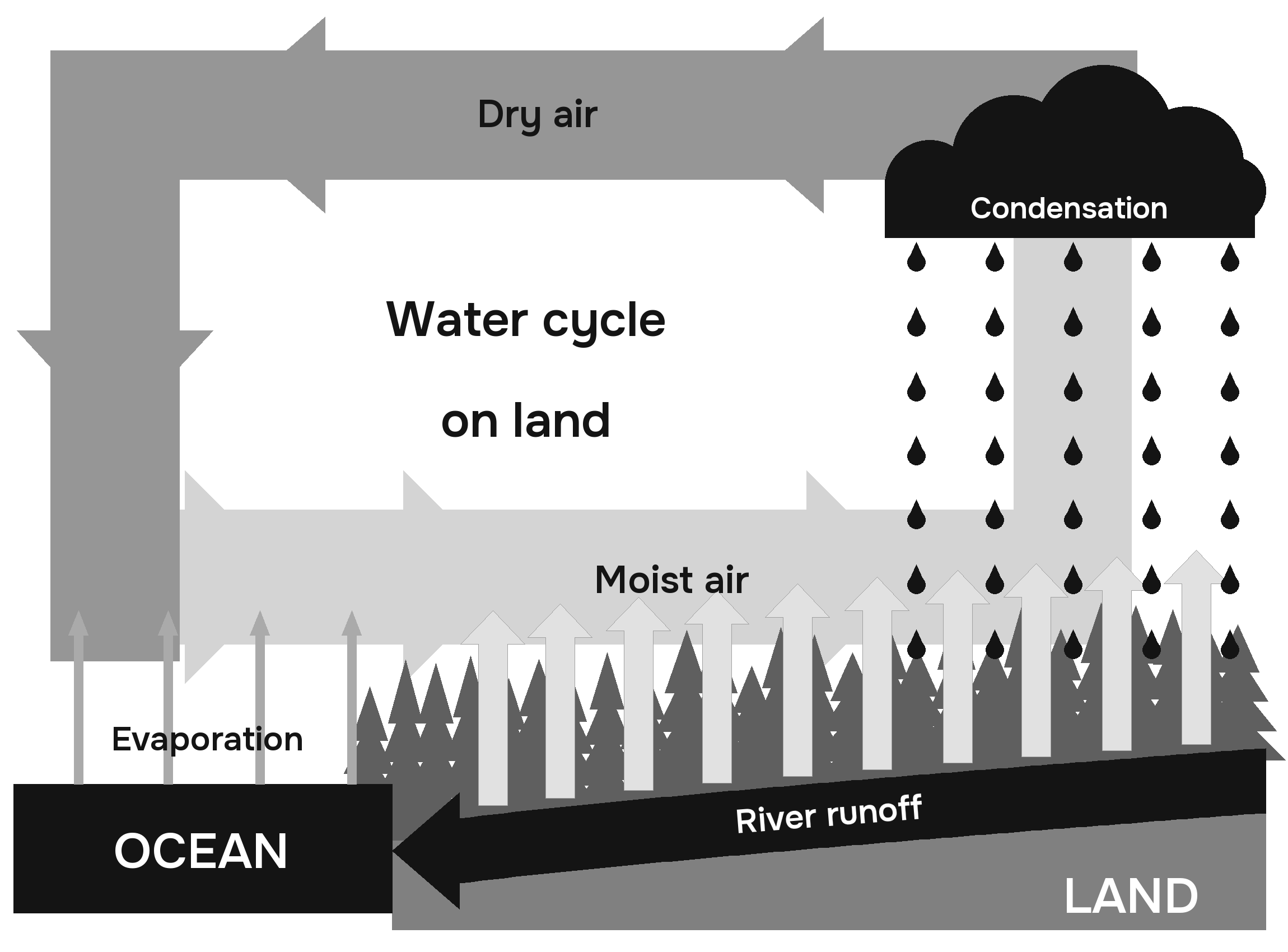
In the desert there is no moisture and—nothing to evaporate. Therefore, a zone of higher pressure is constantly maintained there compared to the ocean, where there is evaporation and condensation of moisture. Thus, the wind in a desert always blows from land to sea, but never in the opposite direction!
This simple but far-reaching physical theory describes how water vapour exhaled by trees creates winds. Thus, Russia's natural boreal forest, stretching for more than 7 thousand kilometres from Northern Europe to the Far East, represents a crucial element of the global biotic forest pump. It supplies freshwater to Western Europe, Russia, Central Asia, Mongolia, and China. Thanks to these boreal forests, winds from the Atlantic cross the continent, carrying moist air across Europe and all of Siberia and further into Mongolia and China. These winds bring rains that nourish the lakes and rivers of Eurasia and the gigantic rivers of Eastern Siberia. These same winds bring moisture to the northern plain of China, the granary of the most populous country on the planet. China receives 80 % of its freshwater from the west—and predominantly this is Atlantic moisture sucked in by the natural taiga forests of Eurasia. Furthermore, the transport path of atmospheric moisture occurs in several stages—transpiration cycles with accompanying rain—and takes half a year or more. And this phenomenon contradicts previous information that everyone learns in secondary school. The paradox is that China is located next to the Pacific Ocean, but most of its precipitation is moisture from land far to the west [8].
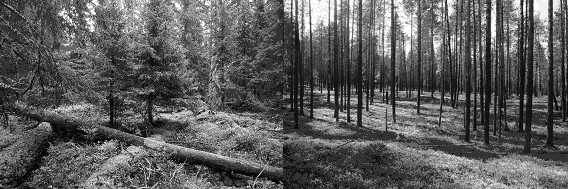
A natural forest is a complex community of uneven-aged trees and other biological species servicing the forest's functioning—bacteria, fungi, insects, birds, and small and large animals. For millions of years, all this intricate activity of the natural forest community has been directed primarily towards maintaining the stability of the freshwater cycle, without which life is impossible. When part of the coniferous forest cover is destroyed as a result of natural cataclysms (hurricanes, lightning strikes, etc.), natural recovery processes (succession) come into play. Such a process is called self-recovery, and in natural conditions it takes more than a hundred years [9].
Deliberate clearing and burning of forest tracts, fires due to negligence, and the extermination of native forests lead to severe disruption of moisture evaporation processes on land. If the areas of destroyed forest are substantial, erosion of zones of low atmospheric pressure occurs. This leads to an abnormally hot spring and a rainy, cold summer. The mechanism of the biotic forest pump transporting atmospheric moisture from coastal marine zones deep into the continent becomes poorly regulated (the pump “sneezes”). Anomalous weather events become more frequent, such as droughts accompanied by fires, or catastrophic floods, when huge masses of water abruptly arrive on land and inundate settlements, agricultural lands, and other territories, leading to a surplus of freshwater that cannot be utilized and causing catastrophic situations where flora and fauna perish and people are forced to flee.
As a result of anthropogenic destruction of natural forest, a protective natural recovery process is also set in motion. In these cases succession proceeds extremely slowly, over many decades—all biodiversity of the natural forest has been destroyed. Deciduous trees on clearings and burn areas do not establish quickly. They cannot provide the draft of moisture from the ocean in the spring months prior to the emergence of foliage and, correspondingly, an adequately high level of evaporation. As a result, drought occurs deep within the continent and catastrophic floods occur in coastal regions, where all the moisture that has not penetrated inland accumulates.
The complete destruction of virgin forests blocks the biotic pump in question and turns any river basin into a desert over a time scale of several decades. In the past century, dramatic consequences resulting from a sharp deficit of falling precipitation led to the disappearance of the Aral Sea. The basin of the once-abundant Amu Darya and Syr Darya rivers that fed the sea became desiccated [10].
What is the value of natural forests?
In 1986–1997 in the USA, in the State of Arizona, a highly instructive scientific research experiment called “Biosphere 2” was conducted. It was the most ambitious biophysical project ever undertaken by the scientific community, costing 200 million dollars at the time (in present-day prices—more than 1 billion). In 1991, eight scientists entered a sealed, glass-enclosed structure covering an area of 1.3 hectares, where they were to remain for two years in isolation from the outside world. Inside the dome, meticulously recreated diverse ecosystems were represented, including a tropical forest, bog, agricultural field, savannah, desert, and ocean with a coral reef. The bionauts were accompanied in their natural habitat by insects, bees and butterflies, fish, reptiles, and mammals, which were carefully selected to sustain the vital functions of the ecosystem. The circulation of air, water, and nutrients was to occur within the system. Its primary purpose was: a) to maintain an atmospheric composition acceptable for humans; b) to serve as a source of food products for the people taking part in the experiment.
After 17 months, the experiment had to be halted ahead of schedule. Due to a drop in the oxygen content under the dome, the people were already breathing thin air, as if at an altitude of 5300 m above sea level. The first and primary lesson: natural components, as in a natural ecosystem, cannot be created by man for any amount of money. The second lesson: there is a real possibility of sudden, dramatic ecosystem changes. The natural environment is a non-linear system, characterized by maintaining dynamic equilibrium under the impact of perturbations, but only up to a certain limit. Thereafter, even small shifts in equilibrium can trigger sharp changes that tip the system into a non-equilibrium state with rapid oscillations, signifying the passing of a point of no return [11].
An artificial accelerated process of restoring a forest akin to a natural one does not justify itself. Artificially planted plantations do not restore or maintain a normal water cycle. Moreover, as numerous examples demonstrate, particularly the failure of the artificial greening of China begun 25 years ago, they are unstable and rapidly degrade from drought or pests. All these facts merely confirm the vital necessity of preserving the natural forests still existing on the planet.
Proposals
In the context of the globally mounting deficit of drinking water, taking into account the key role of natural forests in the sustainable circulation of freshwater, and for the purpose of effective water resource management, the following proposals are submitted for consideration and implementation at both international and national levels:
- designate and legally establish in countries a new category of forests—climate- and water-regulating forests (forest territories little disturbed by humans performing a continental regulatory function in transporting atmospheric moisture from the ocean and in the precipitation regime on land);
- develop a new concept for the development of the timber industry complex, taking into account the fundamental distinction between climate- and water-regulating forests, which are subject exclusively to protection and monitoring, and production forests (for industrial and commercial purposes);
- completely withdraw climate- and water-regulating forests from any economic activity, including leasing and currently popular ecotourism; in essence, these forests must become a specially protected prohibited zone over which even light aircraft do not fly (with the possible exception of drones with environmentally safe engines for monitoring purposes);
- develop production forests (creation of commercial timber plantations) with artificial and combined reforestation, designed to extract maximum economic return through intensive forestry based on modern scientific developments in accelerated tree cultivation; in the turnover of plantation forests, apply the principles of the “circular economy” with deep processing, implementing the most advanced technologies (waste-free production, modern biochemistry products) that contribute to the intensification of consumer forestry;
- provide in national and international programmes for the creation of a new research priority: “Forest and Water: Physical and Biological Foundations of Environmental and Life Sustainability.” The foundation of such scientific research must be an interdisciplinary approach bringing together specialists from diverse fields of science (who currently work in narrow areas without addressing the comprehensive situation and problems on a global scale);
- introduce a mandatory educational course in all universities entitled “Natural-Scientific Foundations of the Sustainability of Forest and Water Reserves in the Biosphere,” as well as conduct special advanced training courses and seminars for civil servants and representatives of industrial and business circles to disseminate knowledge about the “technosphere–biosphere” system as part of the competencies of administrative personnel at all levels;
- in the field of social policy: 1) regard the preservation of natural forests as a unifying factor of international cooperation; 2) create conditions for involving the expert and civic community in addressing issues of natural forest preservation, monitoring and controlling their condition, and exchanging experience between regions and countries; 3) ensure the availability of comparative observational data to the broad international public;
- in the field of nature-like technologies: 1) development of technologies for substituting wood with other materials, especially in the production of paper and packaging materials; 2) introduction of blockchain technologies for controlling timber turnover and eliminating illegal forest exploitation; 3) utilizing the capabilities of information and communication technologies, digitalization, and aerospace observation tools to organize continuous monitoring and forecasting of the state of natural forests using artificial intelligence algorithms; 4) resolving climate change problems with an assessment of the stabilizing potential of the biota and natural forests on such a scale that the capacity of ecosystems is sufficient to maintain the environment and water balance in a habitable condition;
- in the international dimension, seek recognition of Russia and its mission as an ecological donor and guarantor of climate stability in Eurasia and the world. Russia is a scientific leader in the field of fundamental research on environmental sustainability: the birthplace of the concept of biotic regulation of the environment and climate (1995), as well as the global discovery of the forest biotic pump of atmospheric moisture (2005);
- expansion and intensification of international cooperation in the protection of the Eurasian boreal forest belt, since the biotic pump recognizes no state borders and provides freshwater not only to Russia, but also to all countries of Europe and Asia, including China, Mongolia, and others;
- establishment of an “International Interdisciplinary Centre for Boreal Forest Sustainability Research” on the basis of the scientific developments of Saint Petersburg scientists V. G. Gorshkov and A. M. Makarieva;
- utilizing the potential of UNIDO, the SCO, BRICS, and the Geneva Water Hub for cooperation between countries preserving large areas of forests undisturbed by economic activity, including Russia, Brazil, Indonesia, Papua New Guinea, Congo Basin countries, and Canada. Such cooperation must include measures aimed at halting the exploitation of natural forests and developing commercial timber plantations worldwide.
References
- Materials of the UN Conference on Water Resources (22–24.03.2023). UN report on the state of water resources for 2023: https://news.un.org/ru/story/2023/03/1438972
- Report of the Global Observatory for Water and Peace for the UN Midterm Review Conference (March 2023): https://www.genevawaterhub.org/resource/missing-peace-piece-water-puzzle-global-observatory-water-and-peace-brief-un-2023-water
- Jasechko S., Sharp Z. D., Gibson J. J., Birks S. J., Yi Y., Fawcett P. J. (2013) Terrestrial water fluxes dominated by transpiration. Nature 496: 347–350.
- Schiermeier Q. (2010) The real holes in climate science. Nature 463: 284–287.
- URL: https://doi.org/10.1175/JHM–D-12–0190.1; https://doi.org/10.1002/ 2013WR014087.
- URL: https://doi.org/10.5194/hess-11-1013-2007; Biotic pump of atmospheric moisture as driver of the hydrological cycle on land. Hydrology and Earth System Sciences 11: 1013–1033.
- Gorshkov V. G., Makarieva A. M. (2002–2020) https://www.bioticregulation.ru/pubs/pubs2_r. php.
- Pearce F. (2020) https://www.sciencemag.org/news/2020/06/controversial-russian-theory-claims-forests-don-t-just-make-rain-they-make-wind, DOI: 10.1126/science.368.6497.1302.
- Gorshkov V. G., Makarieva A. M. (2007) Biotic pump of atmospheric moisture as driver of the hydrological cycle on land. Hydrology and Earth System Sciences 11, 1013–1033.
- Startsev A. A. (2016) Parizhskoye mezhdunarodnoye soglasheniye po regulirovaniyu klimata: k voprosu o nauchnoy obosnovannosti izbrannogo prioriteta protivodeystviya global'nomu potepleniyu. Rossiyskiy ekonomicheskiy zhurnal. No. 6 (2016), 25–31.
- Startsev A. A. (2012) Unikal'naya priroda Rossii — nadezhda na spaseniye tsivilizatsii. www.ippj.ru Zhurnal «Istoriya. Pravo. Politika». No. 2 (2012), 77–82.