Monograph • 2002
Persistent Organic Pollutants: the Ways of Solving the Problem
Стойкие органические загрязнители: Пути решения проблемы
Content overview
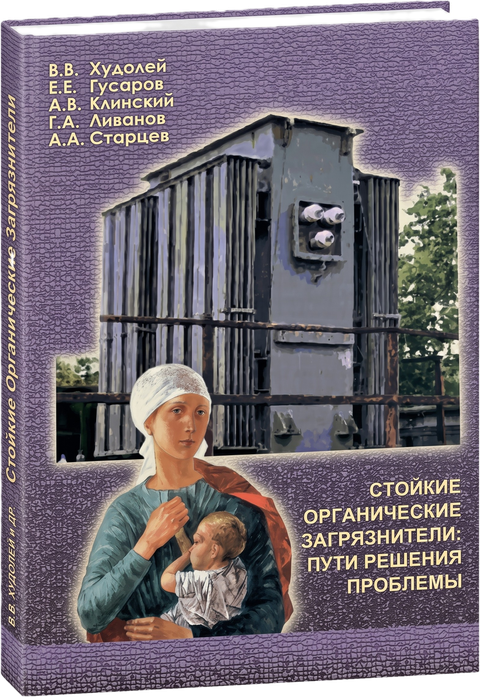
The book deals with the problem of persistent organic pollutants (POPs). According to its annotation, it presents a historical analysis, characterizes the “dirty dozen” POPs, considers the sources, fate and content of these toxicants in the environment, and gives information on the long-term effects of POPs on human health, including the development of malignant tumours and reproductive toxicity.
Drawing on their own work under the scientific programme “Dioxins” and on their participation in international projects and research, the authors use dioxins/furans and polychlorinated biphenyls (PCBs) as examples to consider the ways and possibilities of solving the POPs problem. The book presents the results of studying the accumulation of dioxins/furans and PCBs in the body; according to the authors, the presence of these ecotoxicants in the breast milk of nursing mothers is an indicator of POPs contamination of the environment and of the burden on people. As the annotation states, primary monitoring and an analytical inventory of POPs sources identified “hot spots” in Saint Petersburg and North-West Russia. Legislative and technological approaches to the environmentally sound management of PCBs and of PCB-containing and PCB-contaminated equipment are considered, and the authors present their view of the main provisions of the National Plan and Strategy of Action for implementing the Stockholm Convention.
The book consists of a preface, an introduction, nine chapters, from the history of the “dioxin” problem to the national strategy and plan of action, a conclusion, a section in English (“Conclusion”), recommended literature and the text of the Stockholm Convention on Persistent Organic Pollutants. The preface is signed by V. A. Grachev, corresponding member of the RAN, Chairman of the Committee on Ecology of the State Duma.
Contents
- Preface5
- Introduction8
- Chapter 1. History of the “dioxin” problem14
- Chapter 2. “Dirty dozen” of POPs49
- Chapter 3. Sources, fate and content of POPs in the environment70
- Chapter 4. Consequences of the impact of POPs on humans and the environment89
- Chapter 5. Accumulation and control of POPs in the body116
- Chapter 6. Contamination of the territory of Saint Petersburg and “hot spots”150
- Chapter 7. Inventory of POPs167
- Chapter 8. Environmentally sound management of POPs186
- Chapter 9. National strategy and action plan207
- Conclusion220
- Conclusion262
- Recommended literature303
- Stockholm Convention on Persistent Organic Pollutants312